2: Creating a Peaceful Family

LENGTH 26 Minutes

In today’s episode you’ll learn about overcoming smoking, combining a sense of purpose, and adopting a theme for your marriage, and how all of those things can help develop a healthy, happy and peaceful marriage and family.

Marcus and Ashley Kusi coach couples in their first year of marriage, manage the website OurPeacefulFamily.com where they maintain a blog and podcast focused on building happy, healthy, and peaceful families from the first year forward. The two are parents of a one and a half year old, Ellison, and will soon give birth to a second child. Marcus describes his daughter, “We have a one-and-a-half year old daughter, called, Ellison, and we love her to death. That’s who we are.”

Be sure to connect with them at their blog and social media (linked at the end) and let them know how you've been inspired by their story!

Outward Peace, Inward Peace

Ashley and Marcus Kusi were parents before starting moving their focus toward helping couples through the difficult first year of marriage. Their daughter, Ellison was born prior to their outreach to other couples.

Ashley says one of the reasons they knew they could work on their marriage while helping others in theirs was because they entered their marriage with a clear concept of what they wanted out of the relationship before the entered into it. “We saw what we didn’t want, and we knew what we wanted. So, that really played a huge factor in us actually getting married,” she explains.

No Peaceful, Easy Feeling at First

Saying their relationship wasn’t the typical “boy meets girl” type of situation, Ashley says the two of them were serious and upfront. They told each other, “this is what I wan, and this is what I don’t want.”

One of the things Marcus didn’t want was a wife who smoked or drank. Ashley says that, at the time, she did both.

She stopped smoking, saying it was just her being stupid. “But,” she says, “I am not going to get drunk… I will have a glass of wine every now and then. So, I didn’t just totally give up all of myself, but we compromised and we found that middle ground.”


Developing a Peaceful First Year

Marcus and Ashley say they focus their efforts on strengthening couples in their first year of marriage. “That’s our target,” Ashley explains, “but, we’ve found that actually, a lot of older couples who’ve been married for more than even 10 years, have been giving us the most feedback.”
Marcus says posts like the Appreciating Your Spouse article helps couples “solidify their marriage. And that is something that we – when we get such a feedback, it really helps us keep going. It means that we are doing something and we are impacting marriages.”

A Peaceful Family Theme for Marriage

In the conversation, Confessions of a Terrible Husband host Nick Pavlidis asks Marcus about the concept of a “theme” for a marriage. He replies, “it’s not just a theme for marriage, it’s a theme for your family and your marriage.”

Marcus explains that he and Ashley have chosen for their theme, A Peaceful Family. “So,” Marcus says, “ let’s say 20 years down the road if you want to look at our marriage to see if we’ve been successful or whether we’ve been able to achieve our goals, that’s one goal that we look at.”

Explaining that the theme is a form of accountability for the marriage, he continues, “So, 10, 20, 40, 50 years down the road, that will be the yardstick that we’ll be able to measure the success rate of our marriage.”

Ashley explains further, “You don’t start to build a house without a plan. And I think a lot of people go into marriage, and their just like, ‘well, let’s give this a shot, it’s 50/50 right?’ But, having a goal and a vision for your family and your marriage… really helps set the tone in your relationship. It sets your goals, your personal goals, your goals as a couple, and it helps you to grow together because you’re both working towards a common goal.”

A Plan for Peace

The couple explains how they came up with their theme, A Peaceful Family, even before they were married. “We knew this was the goal we wanted to achieve. We wanted to have a peaceful home that we can raise our kids in, wanted to have a peaceful marriage,” says Marcus.

He says the two then set the plans in place, and began to implement them, even before getting married “we implemented certain things through our daily activities to be able to create a peaceful environment for our home, and everywhere that we go in.”

Marcus says the efforts brought noticeable results as early as a year or two into their marriage. “We went into a grocery store one day to buy ice cream. A guy in his 40’s approached us and told us ‘you guys give off a peaceful vibe.’ Like, he just told us that he really liked the vibe that we give around, wow, if someone that we don’t know has been able to approach us and give us that feedback, then it means we are doing something right,” Marcus exclaims.

An Instrument of Peace

As marriage coaches, Ashley and Marcus don’t teach peace, but teach the process that couples need to take in order to reach their relationship goals and develop a responsible, healthy marriage.

“We want to help them achieve whatever it is [they want to achieve],” says Ashley. “But, then, the basics of any family theme should be to have a happy, obviously, marriage, and a healthy relationship.”

Nick comments that the theme for his podcast and blog, Confessions of a Terrible Husband is personal responsibility in marriage. “I talk about the little things. So, for example, you can do all of the big things right. You can be faithful, you can be gentle, you can work hard and everything like that. But, if you do enough of the little things wrong, that makes you really just bad at being a spouse, in my words.”

Marcus continues, saying that when he gets home from school and his daily errands, “I could see my wife is tired, she’s been with our daughter all day long. So, what I usually do is put everything aside and sometimes I’ll give her a hub and a kiss. And, I’ll give my daughter a hug and try to spend some time with her along, so that Ashley can have her own time and just relax.”

Ashley says that’s a big thing.  But, “it’s all the little things. Because if he did just the big things it wouldn’t work for me… the little things he does with me like playing with our daughter, and I get to just watch them play, and it just makes me fall in love with him over and over again.”

Peace Over Struggles

Marcus admits that he struggles with time management. “I have lots of things going on and it makes it like it’s — they’re all important stuff that I need to take care of.” But, he says, he’s been trying to c”consciously make the effort to spend time with his wife and daughter. “That is the most important thing for me. And, I will say that is something that I used to struggle with, because, initially, it was just me and Ashley. Now, it’s me, Ashley, and Ellison. So, I have to make that conscious effort to spend time with them.”

The book "Love and Respect" comes recommended by Ashley and Marcus Kusi in episode 2 of the "Confessions of a Terrible Husband" podcast.
Ashley says her daily struggle continues, but has gotten better. “I think it all stems back from just selfishness as a person. Sometimes, I let my emotions get the best of me, and I have to remember to really ask him or think the best… especially when it comes to quality time because that’s my love language.”

She says one of the books she and Marcus read during their first year of marriage that helped in the process of understanding each other is Dr. Emerson Eggerichs’ Love and Respect. “It really just talked about thinking the best of your spouse, they’re not purposely trying to hurt you, which was important because in the beginning of our marriage, a ton of my insecurities came out that I didn’t even know were there.”

She says the book helped her understand that Marcus wasn’t trying to make her feel rejected when he was too busy to so spend time, or show appreciation for her. “It really just kind of checked me and made me look at myself and be like, ‘ok, wait a minute here, this is just your emotions and you need to take responsibility for them.

How Husbands Can Improve Their Marriages

Nick Pavlidis asks Ashley to tell husbands listening the one thing they can do to make their relationship better.

“I would say that you need to make time to connect with her, and to learn how she feels connected. Because not everybody feels connected in the same way, and it could change. It could be one way today, it could be another way tomorrow or next week…. so just keep pursuing her, and let her feel connected to you.”

Recommended Marriage Resources

Marcus Kusi says this book helped strengthen his marriage in episode 2 of the "Confessions of a Terrible Husband" podcast.Marcus offers a book for families that had an impact on their marriage. The Total Money Makeover by Dave Ramsey, “that really impacted our marriage,” Marcus continues, “it gives us a whole different perspective on money. I had a totally different perspective on money and Ashley had another perspective…. so I just recommended this book and she read it and it got her thinking about it.”

Ashley says the book “opened up lines of communication we wouldn’t otherwise have known about, or topics to talk about.”

Marcus says he and his wife listen to the One Extraordinary Marriage show by Tony and Alisa DiLorenzo every week, usually in the car when they’re going somewhere. “That is something we do every weekend. That has also helped us improve our marriage in different ways,” he says.

How to Connect with Marcus and Ashley

photo22The two can be found on Facebook at Our Peaceful Family. Or you can visit their website at ourpeacefulfamily.com. Marcus suggests that you start with their getting started page first, so you can get a feel of the website, and then look at the about page to learn a little bit more about them as a couple and as marriage coaches.

While you’re on their page, check out their new podcast, as well.

1: Fawn Weaver, Traveling the World for the Secret to a Happy Marriage

I'm super excited to introduce the Confessions of a Terrible Husband Podcast! You can listen to it right in the post or on iTunes and Stitcher!

LENGTH 27 Minutes

Secrets to a Happy Marriage: An Interview with Fawn Weaver from the Happy Wives ClubThe Happy Wives Club has grown into a worldwide movement. Confessions of a Terrible Husband's first guest is it’s founder, Fawn Weaver. Fawn is a USA Today and New York Times bestselling author, leads more than 600,000 women in the Happy Wives’ Club. Fawn is married to her husband, Keith, since 2003. She’s a proud wife, and, of course, a happy wife.

In today's episode, you'll learn that sex isn't what makes a great marriage, but a great marriage can make for some great sex! You'll also learn the one thing you can do to possibly make your way off of the lumpy couch and back into the heart of the woman you love.

Her advice is out of this world!


Welcoming Fawn Weaver!

Nick begins the interview with a question concerning something most people might not know about Fawn.

“There’s only two things remaining [on my bucket list].” Weaver replies quickly, “One is to go to Antartica… the second thing is to go through Yoga teacher training.”

Saying she loves yoga and running, she reports that her husband “surprised me with a pre-birthday gift, and he said, ‘I noticed that you’re in town for the next month, so I think you should clear your schedule for two of those weeks.”

Her husband, Keith, had reserved two weeks of Yoga Teacher training.

Out of Frustration Comes The Happy Wives Club (3:50)

Happy Wives Club Book, by Fawn WeaverNick was introduced to the Happy Wives Club book by a common friend, Genevieve West. When Fawn was releasing her book, West tweeted to Nick, asking if he would be interested in reviewing the book, when it came out, on his blog, Confessions of a Terrible Husband.”

“It was a little bit surprising,” says Nick, “because I hadn’t heard of the Happy Wives Club… the first thing that hit me was not the book tour, not connecting you with someone, it was the Happy – they have a club for that!”

He says that since he posted the review he has regularly followed Fawn’s website, HappyWivesClub.com “What’s so fascinating to me, is that something so… powerful had its roots [in] boiled over frustration about what you call the onslaught of negativity surrounding marriage.”

Fawn recalls the story of she and her husband on a “Frozen Yogurt Date,” when she sees in the window of a book store, “one of the many, many books that are down on marriage… and I remember looking at that, and, for whatever reason thinking about the fact that Desperate Housewives was number one rated at the time, and the Real Housewives were just starting to pop up in every town near you.”

At that moment, walking through a parking lot, Weaver expressed her frustration to her husband. “I was so frustrated at how I, as a wife, am being portrayed like a caricature. I said, ‘we don’t do that. I don't know anyone that lives like that on TV.”

Fawn then determined to start a club for wives like me, and as she was declaring her intentions to her husband, she says, “And I'm going to name it… and I just kind of paused for some brilliant thing to come to mind. And, the first thing that popped in my mind was ‘The Happy Wives Club.’”

Her husband doubled over with laughter, saying it was the corniest name he had heard, and asked her what time she would use to launch the club.

Fawn says she went on SquareSpace, put up a mission statement, offer an opportunity to join the club, and appeal to those women “tired of hearing all the negativity, and seeing all the negativity, and just want to find other women, or know other happily married women out there exist, join the club.”

Four weeks later, the Happy Wives Club had expanded from 5 women within 20 miles of her, to 22 countries.

Growth of The Happy Wives Club (8:10)

Fawn says the club grew at a time when social marketing wasn’t what it is today. “When you have women that are literally emailing each other, I was able to track down where the women from Europe came from… the woman in Canada who had emailed in Europe, because they were doing it by email.”

“That is how the club started,” she says, “I was absolutely tired of wives turned into caricatures and just wanted there to be us out there, the other side, me, your wife, all of the girlfriends that I have, we don’t act like buffoons, and our husbands are not cheating jerks.”

From a Club to the Happy Wives Club Book (9:00)

Fawn, who at the time was a hotel manager, found that she was always one degree of separation from people in other countries. Reaching out to them, she asked for references to “that couple who you have watched with your own eyes for at least 25 years, and you will say they’re genuine, happily married, love and adore each other, and if you ask anyone in the community who’s marriage you want to emulate, they would point to this couple.”

From there, Fawn was able to fly out to interview those couples.

She says that a lot of the interviews didn’t make the book because the publisher told her she was going to have to cut the book she was working on by about 25,000 words.

The Secret to a Happy Marriage (11:00)

Nick asked if she withheld any secrets to a happy marriage when she stopped writing. “The thing is,” Fawn replies, “is that every marriage, which you know, had these 12 universal secrets.” She says she expected to find just one secret, but was surprised to find that there were 12.

“The most surprising,” she says, “when you think about it, I’m talking to people in South Africa, Winnipeg, Canada,the Philippines, London, Rome, Australia, New Zealand. When you think about how different those cultures are… what made a happy marriage was the same, and that surprised me.”

Happy Marriages Arent Defined by Sex (12:30)

Fawn says the was also surprised by the fact that sex did not come up. Saying she had to figure out why sex wasn’t discussed. “What I realized is, when you do all of those things that are in the book that lead to a happy marriage, you cannot not have a great sex life. Because you have this connection with your best friend.. it changes what goes on in the bedroom when you take care of what goes on outside of it.”

She says sex is not the cause of a great marriage, it is the effect of a great marriage. “I’m sure you know as well, a lot of people with great sex and a really bad relationship,” she explains.

The Effect of Ritual on a Happy Marriage (13:30)

When Nick asks “what advice affected you marriage the most?” Fawn says she and Keith discovered the importance of a ritual.

“The very first thing I did, that I was not doing before” is what the couple in her first interview calls their “Morning Board Meeting.”

During that time, the “husband would go downstairs, get two cups of coffee, wife goes and opens all the windows in their apartment, and they get back into bed, sit up against the headboard, and watch the city lights [of Cape Town, South Africa] go on while talking about everything that’s coming up on their day. Anything they didn’t get a chance to talk bout the day before, whatever’s on their mind, it’s a time of connection that they would do every day.”

“And so, this daily ritual that all of these couples had, they all had different ones. Some were in the morning, some were in the afternoon, some were in the evening, but they all had these daily rituals,” says Happy Wives Club founder Fawn Weaver.

Advice to a Busy Wife for a Happy Marriage (16:15)

Fawn recalls a recent speaking engagement at a conference where a woman asked how to have a special time with her husband. “I turned to the women in the room, and said, ‘who’s got a calculator on their phone?’ And, of course, everyone raised their hands, and I said, ‘I need you to calculate this. Calculate 60X24, what is the total?’ 1,440 minutes is what you have in a day. If you cannot subtract out 60 minutes for your marriage, something outside of your marriage has got to go.”

What About the Wife of a Terrible Husband?

Nick notes that Fawn writes and talks often about how supportive her husband, Keith is for her. “You obviously chose your spouse well. Talk to the person out there show i married to someone who might not be as openly supportive, or who might not feel is as supportive.”

“What you give out is what comes back to you,” she starts. “When it comes to matters of respect, do not look at respect as the way your neighbor looks at respect… saying to your spouse ‘what does respect look and feel like to you?’ and then do that.”
“And, what I have found is when you give, not expecting anything in return, is when it comes back to you.”
She also advises, “and then checking back in with them,” asking how your efforts are looking and feeling to them.

Personal Responsibility and Happy Marriages (21:00)

Nick points out the importance of personal responsibility in marriage, noting that Fawn concludes each of her blog posts with the words, “Make it a great day.”

Fawn admits “it’s a lot of work for me. Now, it comes more naturally, especially with my husband. But, everything is something that we have to learn. Everything that is great for the most part, I mean, certain activities some to us.”
“I think it’s Gretchen Reuben who says, ‘Happiness is bringing your own weather to the picnic.’ and that, I believe, that is you have, I have, the power to respond to any situation a specific way.”

What's One Thing We Can Do Today to Make for a Happier Marriage (22:30)

“I would go to your wife, and do exactly what we talked about earlier… say to her, ‘what does respect look and feel like to you’ and then begin to do that.”

She says that a lot of women don’t feel respect. “I have to tell you, I’ve sat across from enough happily married couple that have been married for 30, 40, 50 years, to know, if that respect doesn’t go both ways, and I mean mutual respect, it’s not going to be a happy marriage.”
She concludes with “that is where I would start… and then, check in with her.”

Fawn's Recommended Resource (24:19)

The 5 Love Languages, by Gary ChapmanFawn recommends Gary Chapman’s book The Five Love Languages.

She admits to not having read the book, but, she says, “I’ve only read all the online things and done the assessment, but it was enough… we had been married for nine years… and I was completely wrong about his love language. What I thought was my own love language, was actually his. And what I thought was his was actually mine.”

HOW TO REACH FAWN

HappyWivesClub.com

Facebook

Twitter

Pinterest


Podcast Show Notes and Transcription Services by The Show Notes Guy, Phillip Swindall

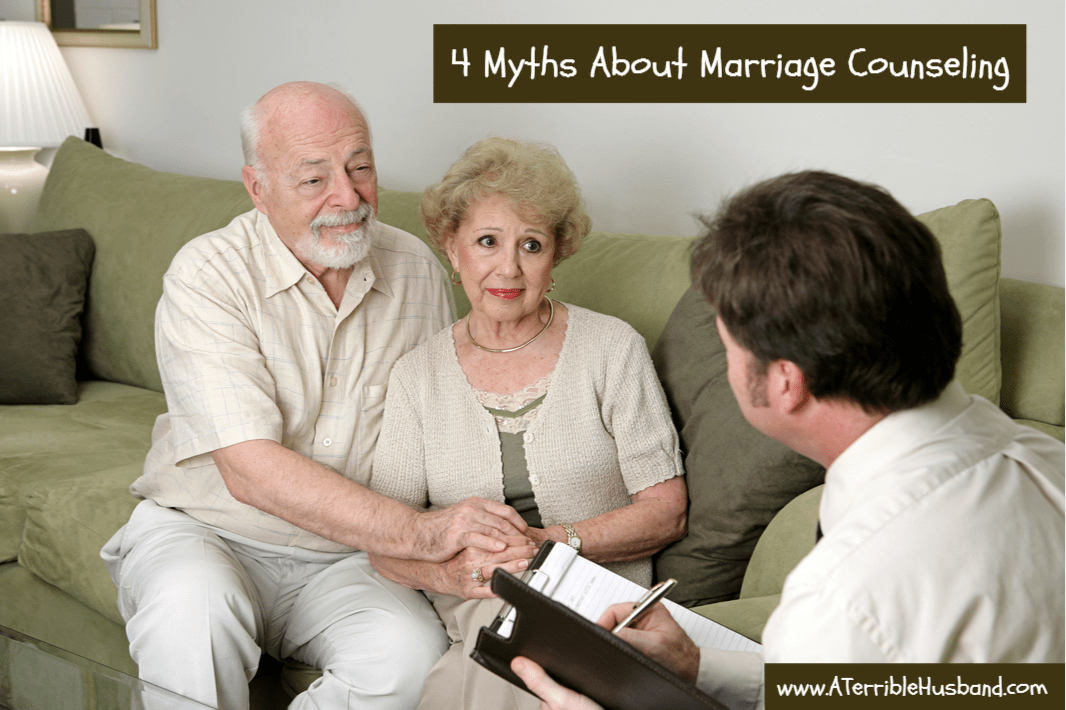
4 Myths about Marriage Counseling

UPDATE: This post has turned into one of the most popular posts on Confessions of a Terrible Husband! Because of that I took a few minutes to talk about it a bit more on the Confessions of a Terrible Husband Podcast. You can listen to the episode by clicking the play button at the bottom of this post or by visiting any of the listening options linked on the top of the page!

Also, if you're interested in joining my upcoming small group marriage mastermind, be sure to sigh up for my email list because I'll be revealing details to the subscribers first! It will be limited to 12 people! Just sign up here on the sidebar, or you can also email me at nick@aterriblehusband.com!

4 Myths About Marriage Counseling

©Depositphotos.com/lisafx

As you might imagine, I've read a lot about marriage over the last few years. As I got more and more uncomfortable with my relationship I looked in more and more places for answers.

Simple google searches. Books about love and respect, happiness, or love languages. Websites that talk about what makes a happy wife. Small groups of people committed to improving their relationships. And, of course, that weekend in Franklin, Tennessee, in May 2013 that proved unintentionally life changing.

All of these things helped me take control of and improve my marriage. But for a long time, one thing was missing, at least my commitment level to that one thing. I didn't know it at the time, but after interviewing several people for the upcoming podcast (which is in post-production with my show notes guy as I type!) I lacked buy-in to one key element of relationship building:

An unbiased neutral facilitator in the same room as my wife and me.

I had done it, but hadn't really bought into it until I got on the line with John G. Miller, the personal accountability guru. When I asked John for his best advice for you and me, his answer shocked me.

John G. Miller is the author of several books, including The Question Behind the Question, Parenting the QBQ Way: How to be an Outstanding Parent and Raise Great Kids Using the Power of Personal Accountability, and Outstanding!: 47 Ways to Make Your Organization Exceptional, an awesome book written for organizations but featuring advice that is equally applicable at home, too.

He is the personal accountability guy. That means he knows the why and the how of taking personal responsibility over things.

But his best advice was to seek a neutral facilitator at times in your marriage. And he confided in us that he and his wife of over 3 decades had done just that.

As you can imagine, when he mentioned a neutral facilitator I listened. And I wondered why I hadn't given it the value that he did before….

In business I'm a big proponent of getting outside opinions. I've hired coaches in my professional life. And I coach high potential individuals on how to build strong businesses and successful careers without leaving their families behind.

So why hadn't I valued it with my marriage before? Why did I just go through the motions with it before?

I've asked myself those questions several times since then. And every time I did, I came up with the same answers.

4 Myths About Marriage Counseling

1. You don't need it.

For the longest time I thought I didn't need it. I was a big personal accountability guy. I helped make the mess. I can help clean it up. What would a counselor offer to us that I couldn't do myself? “If we just [enter any number of things],” then we would be all set. Yet weeks or months would go by and we'd be in the same cycle over and over. We would not put any focus on “our issues,” but rather just get busy with the day-to-day that is raising two kids and managing lives.

But having weekly, bi-weekly, or monthly sessions with a coach or marriage counselor forces you to pause from all that and focus openly on what you can do to improve your relationship. So, yeah, we've started doing that. That focus, with someone there to facilitate the conversation, is definitely “needed.”

Sure, some (or all) of what a session with a neutral facilitator could be done by yourselves at home with proper discipline and perspective. But we hadn't done it yet…. So….

2. Only the weakest couples get it.

If the first part of this post didn't convince you that this is a myth, I don't know what will. The most successful people in sports and business have coaches, counselors, consultants, and others pouring into them. What makes you think marriage is any different?

3. It means you're weak.

This was tough for me. I am a personal accountability guy. I am “Mr. Fixit.” What does it say that I can't fix my marriage alone and need outside help?

It froze me for a while. But, again, if the best in business and sports have outside help, marriage shouldn't be any different.

In fact, choosing to get outside help is a pretty bold decision in my book.

If anything, making that choice might indicate strength, rather than weakness.

4. It will work like magic.

The thing about any counseling or coaching is that it puts you in the best position to make positive changes in your life.

That's where the personal accountability comes back into play. No coach or counselor is going to give you all the solutions for your life. They can help guide you and provide you with a safe environment to explore what your current situation is and what might need to be done to improve it.

But your coach or counselor is not going to be around 24/7 to make every choice for you. You need to do that.

Coaching or counseling works best when everyone involved is committed to discussing things openly, accepting guidance, and doing things differently.

A counselor will look in from the outside and suggest ways to improve things that you might not see because you're too emotionally invested, biased, or both.

The counselor can provide you a roadmap. But you won't get anywhere unless you follow it.

What other myths about marriage counseling have I missed?

In speaking with several folks who coach or counsel married couples, as well as from being involved in several groups of people who are actively seeking to improve their relationships, one spouse often gets on board with counseling while the other resists.

If you're that resisting spouse, perhaps it's time to ask yourself why you resist.

Do you think it shows weakness? Do you think it's not needed? Are you afraid that it will force you to make an uncomfortable change?

If you liked this post, listen to the podcast episode. I chat about a lot of this and go a bit deeper into my thoughts on it along with a special announcement about a way to connect deeper with me!

Listen Here:

10 Ways You Are Making Your Marriage Tougher Than It Has To Be.

UPDATE: This post has turned into one of the most popular posts on Confessions of a Terrible Husband! Because of that I took a few minutes to talk about it a bit more on the Confessions of a Terrible Husband Podcast. You can listen to the episode by clicking the play button in this post or by visiting any of the listening options linked on the top of the page!
Harder (2)Today's “viral website life lesson that applies equally to marriage as anything else” comes to you from Tim Hoch over at Thought Catalog.

Tim is a fellow lawyer and mistake maker who provides 10 spot-on ways you're making your life harder than it has to be.

But just like most business and life lessons, Tim's 10 tips can help you make your marriage easier by simply asking yourself how the principles apply specifically to your marriage.

His tips are below. And my thoughts and responses to each of them follow.

So… let me know in the comments. How are you making your marriage tougher than it has to be?

And here's the podcast episode where I talk a little bit more about this list! To subscribe to the podcast you can head on over to iTunes or Stitcher.  You can also listen to more episodes on Facebook, JoyRide, or right here on the site!

1. You ascribe intent.

Does your wife squeeze the toothpaste from the middle because she hates your mom? Is your husband 20 minutes late for your family reunion because he secretly thinks he should have married his ex?

Probably not. She probably just squeezed it from the middle growing up. And he's probably just bad with time. I bet he runs late for other things, too.

So slow down for a second. Stop trying to connect the dots. You'll be much happier.

2. You’re the star of your own movie.

When your wife says she had a rough day do you give her a hug and ask how you can help her? Or do you say “you think that was bad, I got stuck in traffic and my boss didn't let me grab lunch?!?!”

It's not always about you, dude. Take a supporting role and watch the bliss happen.

3. You fast forward to apocalypse.

The world is not going to end because your wife shrunk your best shirt that they don't make anymore. You will not end up homeless because she accidentally forgot to pay a bill on time.

Yes, perfectly avoidable things happen. Annoyances happen. Relax. At least you still have internet access… it can't be that bad.

4. You have unrealistic and/or uncommunicated expectations.

What do you expect from your wife? If your answer sounds like “not much. As long as the kids are fed, washed, in bed by 7:30, asleep by 7:45, and oh yeah, she needs to make more money than me so I can travel the world to establish myself as the best nature photographer on the planet,” you're probably pretty miserable.

And you are probably pretty disappointed with your wife.

On the other hand, you're probably rockin' it on all levels if your answer sounds like “we both expect to love and respect each other and make sure if there are any specific things we want or need to bring it up during one of our many chats.”

So which one are you closer to? I definitely went through a patch of unrealistic and uncommunicated expectations. And, well, this blog wouldn't be called Confessions of a Terrible Husband if it worked out well….

5. You are waiting for a sign.

If you're waiting for someone to tell you to do something nice for your wife, read all the way down to the copyright notice at the bottom of this page. You're welcome.

6. You don’t take risks.

When's the last time you opened up to your wife about something that scares you? How about the last time you sought out a marriage mentor? Got coaching? Saw a counselor?

Those things are risky and could result in uncomfortable conversations, hurt feelings, rejection, feeling inadequate, or feeling like a failure.

But they also could begin a conversation that leads to truly connecting with your wife.

7. You constantly compare your life to others.

You know that couple that's always hugging, kissing, going on vacations, losing weight, climbing mountains, winning the lottery, and meeting famous people on Facebook?

Their lives aren't perfect either. They just don't post the crappy parts, like the bills, illnesses, loss, insecurities, or failures on Facebook. So stop comparing the highlights of their lives to your day-to-day grind, cool? Just focus on what you can do to create more meaningful moments and connections with the people closest to you and you'll be just fine.

8. You let other people steal from you.

You wouldn't hand your wallet to a stranger and say “go as far as it will take you,” would you? Why not?

Aside from the creep-factor and potential identity theft, it's because you want the content of that wallet to provide for your family's future, right?

So why do you let people steal time or energy from you that you could use to connect more meaningfully with your family?

Set up boundaries around your marriage and you'll be well on your way to a more meaningful marriage.

9. You can’t/won’t let go.

This one is pretty self-explanatory. But here's a hint. If you think or say “this is just like the time…,” “you always,” or “you never,” you need to let go of something.

Create a list of things that you need to forget. And move on. Please.

10. You don’t give back.

Make it a habit of making deposits into your marriage and giving back to your wife without expecting anything in return. A good rule of thumb is to make giving versus asking no less than a 3 to “stop counting jerk” ratio to achieve true happiness.

So there you have it. 10 Ways You Are Making Your Marriage Tougher Than It Has To Be.

Numbers 1, 4, 6, and 8 are my biggest issues. How about you?

How are you making your marriage tougher than it has to be?