

Also, if you're interested in joining my upcoming small group marriage mastermind, be sure to sigh up for my email list because I'll be revealing details to the subscribers first! It will be limited to 12 people! Just sign up here on the sidebar, or you can also email me at nick@aterriblehusband.com!
©Depositphotos.com/lisafx
As you might imagine, I've read a lot about marriage over the last few years. As I got more and more uncomfortable with my relationship I looked in more and more places for answers.
Simple google searches. Books about love and respect, happiness, or love languages. Websites that talk about what makes a happy wife. Small groups of people committed to improving their relationships. And, of course, that weekend in Franklin, Tennessee, in May 2013 that proved unintentionally life changing.
All of these things helped me take control of and improve my marriage. But for a long time, one thing was missing, at least my commitment level to that one thing. I didn't know it at the time, but after interviewing several people for the upcoming podcast (which is in post-production with my show notes guy as I type!) I lacked buy-in to one key element of relationship building:
An unbiased neutral facilitator in the same room as my wife and me.
I had done it, but hadn't really bought into it until I got on the line with John G. Miller, the personal accountability guru. When I asked John for his best advice for you and me, his answer shocked me.
John G. Miller is the author of several books, including The Question Behind the Question, Parenting the QBQ Way: How to be an Outstanding Parent and Raise Great Kids Using the Power of Personal Accountability, and Outstanding!: 47 Ways to Make Your Organization Exceptional, an awesome book written for organizations but featuring advice that is equally applicable at home, too.
He is the personal accountability guy. That means he knows the why and the how of taking personal responsibility over things.
But his best advice was to seek a neutral facilitator at times in your marriage. And he confided in us that he and his wife of over 3 decades had done just that.
As you can imagine, when he mentioned a neutral facilitator I listened. And I wondered why I hadn't given it the value that he did before….
In business I'm a big proponent of getting outside opinions. I've hired coaches in my professional life. And I coach high potential individuals on how to build strong businesses and successful careers without leaving their families behind.
So why hadn't I valued it with my marriage before? Why did I just go through the motions with it before?
I've asked myself those questions several times since then. And every time I did, I came up with the same answers.
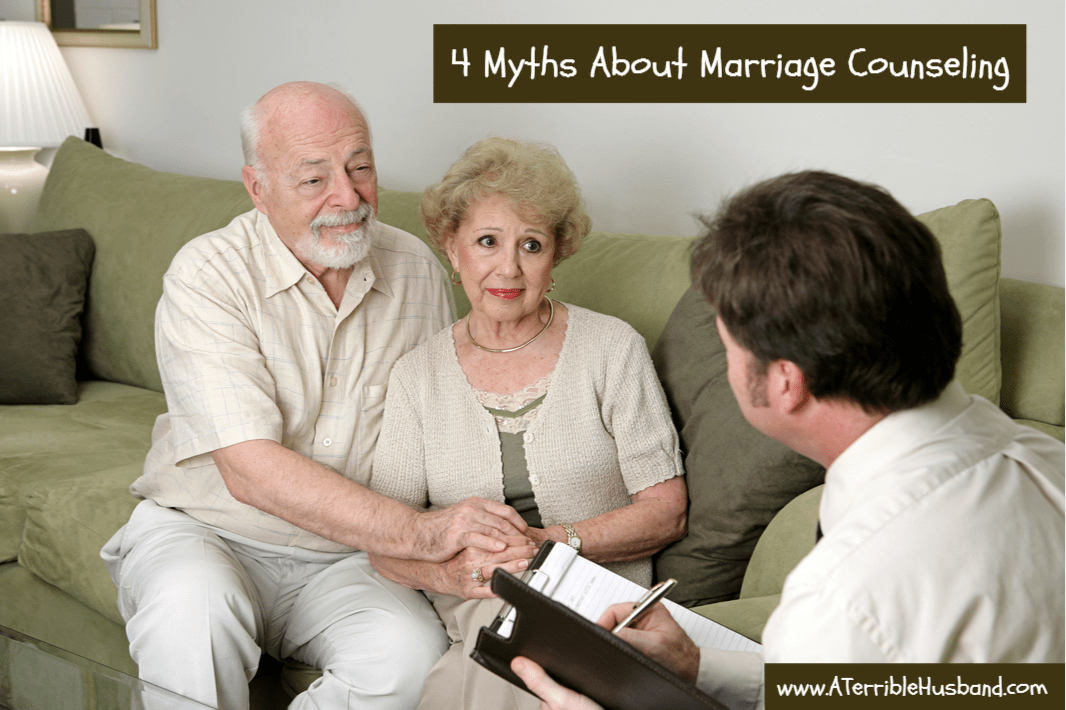
4 Myths About Marriage Counseling
1. You don't need it.
For the longest time I thought I didn't need it. I was a big personal accountability guy. I helped make the mess. I can help clean it up. What would a counselor offer to us that I couldn't do myself? “If we just [enter any number of things],” then we would be all set. Yet weeks or months would go by and we'd be in the same cycle over and over. We would not put any focus on “our issues,” but rather just get busy with the day-to-day that is raising two kids and managing lives.
But having weekly, bi-weekly, or monthly sessions with a coach or marriage counselor forces you to pause from all that and focus openly on what you can do to improve your relationship. So, yeah, we've started doing that. That focus, with someone there to facilitate the conversation, is definitely “needed.”
Sure, some (or all) of what a session with a neutral facilitator could be done by yourselves at home with proper discipline and perspective. But we hadn't done it yet…. So….
2. Only the weakest couples get it.
If the first part of this post didn't convince you that this is a myth, I don't know what will. The most successful people in sports and business have coaches, counselors, consultants, and others pouring into them. What makes you think marriage is any different?
3. It means you're weak.
This was tough for me. I am a personal accountability guy. I am “Mr. Fixit.” What does it say that I can't fix my marriage alone and need outside help?
It froze me for a while. But, again, if the best in business and sports have outside help, marriage shouldn't be any different.
In fact, choosing to get outside help is a pretty bold decision in my book.
If anything, making that choice might indicate strength, rather than weakness.
4. It will work like magic.
The thing about any counseling or coaching is that it puts you in the best position to make positive changes in your life.
That's where the personal accountability comes back into play. No coach or counselor is going to give you all the solutions for your life. They can help guide you and provide you with a safe environment to explore what your current situation is and what might need to be done to improve it.
But your coach or counselor is not going to be around 24/7 to make every choice for you. You need to do that.
Coaching or counseling works best when everyone involved is committed to discussing things openly, accepting guidance, and doing things differently.
A counselor will look in from the outside and suggest ways to improve things that you might not see because you're too emotionally invested, biased, or both.
The counselor can provide you a roadmap. But you won't get anywhere unless you follow it.
What other myths about marriage counseling have I missed?
In speaking with several folks who coach or counsel married couples, as well as from being involved in several groups of people who are actively seeking to improve their relationships, one spouse often gets on board with counseling while the other resists.
If you're that resisting spouse, perhaps it's time to ask yourself why you resist.
Do you think it shows weakness? Do you think it's not needed? Are you afraid that it will force you to make an uncomfortable change?
If you liked this post, listen to the podcast episode. I chat about a lot of this and go a bit deeper into my thoughts on it along with a special announcement about a way to connect deeper with me!
Listen Here:
Podcast: Play in new window | Download
Please note: I reserve the right to delete comments that are offensive or off-topic.